Have you been told you can't have air conditioning in your Cheltenham Home?
Our fully internal air conditioning system is designed for Cheltenham's listed and period homes, where installing an external unit isn't an option. Nothing is fitted to the outside of your home.

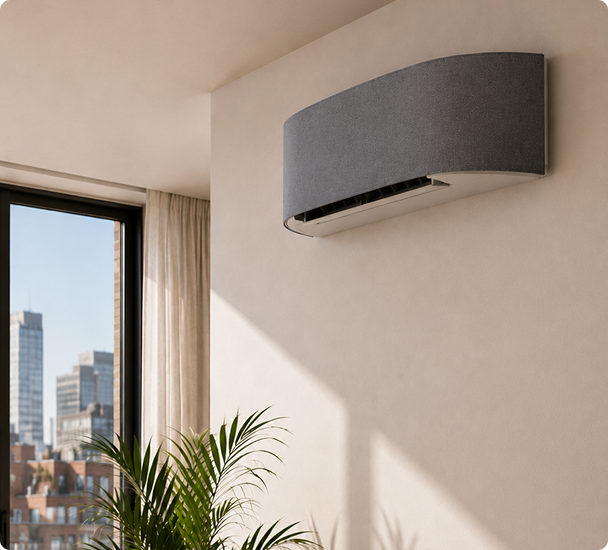
Cheltenham's Regency homes weren't built for hot summers.
You've invested in a beautiful property in Cheltenham. It might be a flat in a converted Regency villa in Montpellier or Lansdown, a townhouse in Pittville, or a period home just off the Promenade. You love the tall sash windows, the high ceilings and the original plasterwork. But those same windows let the summer sun pour in, and the top floors under the soak up heat all day, exactly what you want in February, but not in July.
By early afternoon the rooms are in the high twenties, and they're still holding the heat at midnight. For property owners in Cheltenham this isn’t just a two-week heatwave problem anymore, it goes on for months, from May through to September.

Your hot home affects more than your comfort.
Your Sleep
A top-floor bedroom that's been soaking up heat all day takes hours to cool down. You struggle to get to sleep, wake throughout the night, and start the next day tired rather than rested.
Your Work
If you work from home, by early afternoon it's uncomfortably hot to concentrate. The productive day you planned goes out of the window, and you spend the rest of the week catching up.
Your Evenings
Your home, the place where you would normally enjoy spending time winding down and relaxing, becomes a place you no longer want to be and try to avoid.
Your Property
Your home is a special building full of character, and you want to keep it that way. Ugly portable units with hoses out of the windows and fans in every room don't belong in it. Additionally, if you let the property, overheating is also one of the most common reasons tenants leave.
Why conventional air conditioning isn't an option in your home.
A conventional air conditioning system needs a condenser fitted to an outside wall, roof or garden. In a listed or period Cheltenham home, that usually isn't possible for one of these three reasons.
Your home is listed.
Cheltenham has more than 2,600 listed buildings. Fitting an external unit to one needs Listed Building Consent as well as planning permission, and an external A/C condenser has little chance of approval.
You’re in a conservation area.
Cheltenham's Central Conservation Area covers the whole town centre and most of its Victorian and Edwardian suburbs, including Montpellier, Pittville, Lansdown, Bayshill and the Old Town. Even if your home isn't listed, an outside condenser box is likely to be refused.
Your flat is in a converted building.
Many of Cheltenham's Regency villas and terraces have been divided into flats. The freeholder or management company controls the exterior, and condenser requests are often declined or take months to answer.
The other solutions you’ve probably tried already.
Portable units
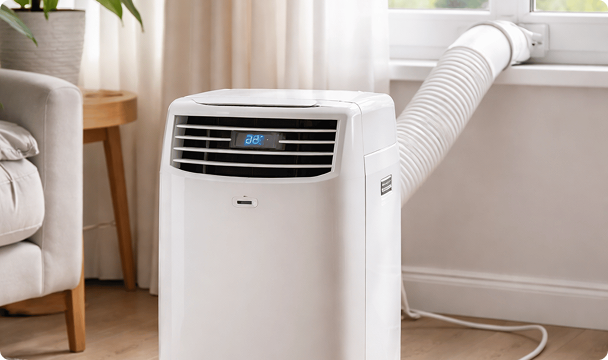
They need a window left open for the exhaust hose, which lets warm air and street noise straight back in. They're loud, they need draining, and they take up floor space in the room you are trying to cool.
Fans
They just circulate warm air around the room without actually lowering the temperature at all.
Blackout blinds
They reduce some of the sun's heat but darken the room, and the heat stored in thick walls and roof spaces keeps coming through.
Having been told no to conventional air conditioning and trying these workarounds can leave you feeling out of options, but you're not. Up until now most homeowners in Cheltenham have simply never been told this option exists. Our air conditioning system allows you to achieve a perfectly cool and comfortable apartment without the need for an outdoor unit or altering the outside of your building.
Fully internal air conditioning, designed for listed and period homes in Cheltenham.
Our water cooled air conditioning system is designed for listed and period properties in Cheltenham, where an external unit is not an option. The whole system sits inside your home, nothing is installed outside, and your building's external appearance isn't modified in any way.
So how is it possible?
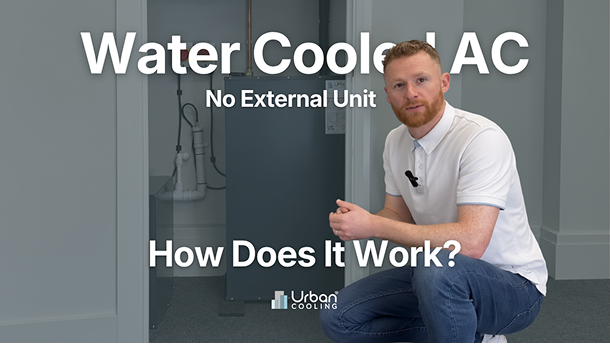
A conventional air conditioning system rejects the heat it removes from your rooms into the outside air. That is the only reason it needs an external condenser mounted on an outside wall or roof. A water cooled system rejects the heat from your property into your mains water supply instead, which means the condenser can be installed indoors.
Because nothing is installed on the outside of your building, you won't need planning permission for an external unit. If your home is listed, we'll talk you through the proposed installation at your free survey, including whether anything is likely to touch historic fabric, and our view on whether the work is likely to need Listed Building Consent. Once you’ve paid an Installation deposit, if required we’ll prepare a written Heritage Installation Plan setting out exactly where everything will go, and can be used to support your Listed Building Consent application.

Water cooled compared with a conventional system.
The system does the same job. The difference is where the heat goes, and everything that follows from that.
Water Cooled Air Conditioning
A fully internal system without an outdoor condenser.
- No external unit required
- No planning application for an outdoor unit
- Building exterior and roof untouched
- Pipe routes planned around original features
- Cools as well as conventional A/C
Conventional Air Conditioning
A split system with an outdoor condenser.
- External unit required
- Planning permission usually required
- Listed Building Consent rarely granted
- Visible unit alters a historic exterior
- Less efficient on the hottest days
What's actually installed in your home.
Water Cooled Condenser
The water cooled condenser is installed inside a utility cupboard, under-stairs or airing cupboard, where the unit can be plumbed into your existing cold water supply, waste and electrics. It can provide cooling capacity for up to 5 wall units and is rated A+ for electrical efficiency.
Wall Units
Choose from our two wall units - Urban Signature and Urban Designer which comes with interchangeable textile covers in a choice of colours. Or opt for our Urban Ducted range, which conceals a ducted unit in a loft void, bulkhead or false ceiling, leaving only a slim grill visible.
Refrigerant Pipework
The water cooled condenser and wall units are connected via thin refrigerant pipework which is carefully run through your property, keeping clear of cornicing, panelling and other original features. Any small access holes are made good afterwards, so there are no leftover holes, marks or mess.
The three things everyone asks us.
We understand this may be the first time you've heard of water cooled air conditioning, so you've most likely got a few questions you'd like answered. Here are three that come up in most conversations we have with customers...
What happens if a pipe bursts inside my property?
Only refrigerant gas flows through the pipework connecting the units. Water never leaves the condenser, and no water passes through the pipes connecting the wall units.
If the pipes connecting the units were to be damaged, the only thing released would be refrigerant gas, which is harmless and evaporates into the air. There would be no water leaks or any water damage, as there is no water in the pipes.
All of our water cooled condensers are manufactured to the highest standards, with all internal components fully brazed to minimise the risk of leaks. In practice this makes the likelihood of a water leak similar to that of a washing machine or dishwasher already installed in your home.
Does it cool as well as a conventional system with an external unit?
Yes. A water cooled system will cool your room to the same temperature as a conventional system, typically around 18°C, and on the hottest days it can actually be more effective.
Our condensers provide a cooling capacity of up to 15kW and a cooling power input of up to 5kW, with one condenser able to cool up to 5 rooms at once. That makes our water cooled systems as powerful and as efficient as any conventional air conditioning with an external condenser.
On the hottest days, a water cooled system can actually be more effective than a conventional one. A conventional system has to reject heat into the outside air, which becomes harder the hotter that air gets. When outside temperatures are above 30°C, the water entering your property typically stays at around 20°C or below, therefore our system can remove heat more efficiently on the days you need it most.
Is the technology proven, and are parts available?
We have been installing fully internal water cooled air conditioning systems for over 10 years and have completed more than 1,000 successful installations, from city-centre one-bed apartments to listed buildings valued at over £5 million.
If you look through our 450+ reviews, you’ll see how we have transformed the properties of many customers who were once in the same position as you.
Our units are designed and assembled in the UK to UKCA standards. We hold parts, and every system we install is fitted and maintained by our own engineers and dedicated aftercare team.
Like any air conditioning system, a water cooled system needs servicing to run efficiently and last as long as possible. We recommend a professional service once a year. Regular maintenance prevents breakdowns, improves performance and keeps the system running at peak efficiency.
More Frequently Asked Questions
Do I need to get planning permission or Listed Building Consent to install water cooled air conditioning in my Cheltenham property?
Because nothing is installed outside and the exterior of your home remains unchanged, you won’t need planning permission for an external unit, which is usually the main hurdle.
However, Listed Building Consent is a separate matter. Cheltenham Borough Council is clear that consent covers alterations to both the exterior and the interior of a listed building. Whether your installation needs it depends on your building and where the system goes.
If your home is listed, we’ll talk you through the proposed installation at your survey. This includes whether any of the work is likely to affect historic fabric and our view on whether Listed Building Consent is likely to be needed. If you decide to go ahead, once you’ve paid the installation deposit we can provide a written Heritage Installation Plan. This plan sets out exactly where everything will go, and can be used to support your Listed Building Consent application.
If your home is in a conservation area but isn’t listed, internal works don’t normally need consent.
How much water does the water cooled system use?
It’s hard to give an exact figure, as water usage depends on several factors:
Setpoint temperature: The cooler you set the room, the more water the system uses. Cooling a room to 18°C uses more water than our recommended setting of 22–23°C.
Outdoor temperature: The hotter it is outside the more heat is being transferred from the outdoor air to the cooler room being air conditioned, therefore the system’s water consumption increases to remove it.
Building construction: How your property is built affects how much heat it gains and holds. A building with a lot of glass and thermal insulation will absorb external heat and retain it in the building for longer.
Incoming water temperature: The system uses cold water to cool the refrigerant. The colder the incoming water, the less of it is needed to remove the latent heat from the refrigerant.
Running time: A system left on all day will use much more water than one switched on for a few hours to cool a bedroom before bed.
As a guide: An average 5m x 4m bedroom with a typical amount of glazing, insulated to modern building regulations, would need a 2kW indoor unit and a condenser unit. With an outdoor temperature of 27°C and an incoming water temperature of 12°C, the condenser would use around 40 litres of water per hour to cool the room to 22°C.
Our condenser units only use water while they’re actively cooling. Once the room reaches its setpoint, the condenser switches off. Maintaining that temperature typically needs only 20–30 minutes of running time per hour, so water use drops once the room has cooled.
Does the water cooled air conditioning system heat as well as cool?
Our water cooled system does provide heating; however, we advise only using this as a backup and not a primary source of heating for your property.
Can you recycle the water the system uses?
Yes, in some cases. The water leaving the system has been heated to around 45–50°C, so it can be reused. We can connect the unit to a large hot water storage cylinder, which lets you use the heated water for a shower or bath.
However, this isn't always practical, as hot water cylinders take up a lot of space and add to the installation cost, so we’ll let you know at your survey whether it’s an option for your home.
If your building has a communal heating system or a chilled water circuit, our water-cooled condenser can connect to it with no wastewater at all. This is dependent on the water flow temperatures running through those systems, which we’ll check at your survey.
How is the internal water cooled system installed in a listed or period property?
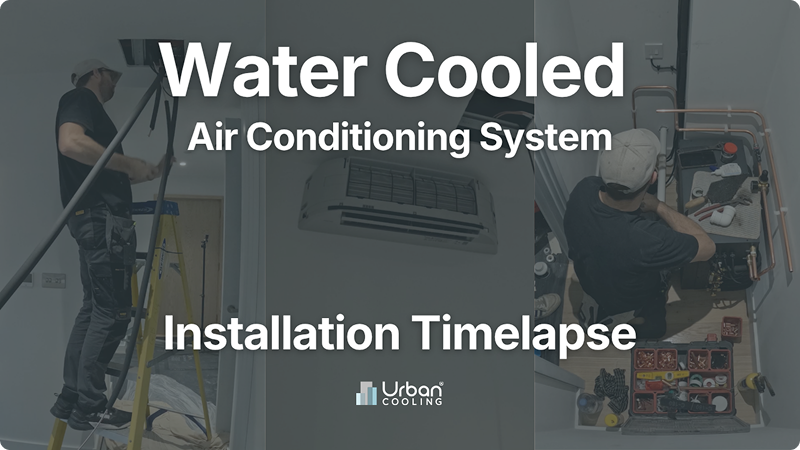
Installation takes on average one day per indoor unit and is carried out by one of our own engineering teams.
First, we install the condenser. It's connected to your water mains, drainage and electrical supply, and its compact design means it can be concealed in a utility room or cupboard.
Next, the indoor units go in. These can be wall mounted, floor mounted or ducted, with one in each room you want cooled. We agree the best position for each at the survey stage, taking your home's original features into account.
Finally, we connect everything together. Two insulated refrigerant pipes and a communication cable run between each indoor unit and the condenser, along the routes agreed at survey. We then pressure test the system and make good any access holes.
Once that's done, we fully test and commission the system and talk you through how to use it before we leave.
Get four months of the year back in your Cheltenham home.
Sleep through the night
From the moment you go to bed until your alarm goes off, your bedroom stays whatever temperature you set it to. The windows stay shut, you no longer wake up at two in the morning to kick the covers off, instead you wake up feeling rested and ready for your day ahead.
Work through the whole afternoon
Your home stays cool through the afternoon, so the second half of your day is as productive as the first. The day you planned is the day you actually have, and you are no longer spending the rest of the week catching up on work you were unable to get done.
Enjoy your home all summer
Even on the hottest days of summer, your home becomes the place you enjoy winding down and relaxing at the end of the day. You no longer feel like you're trying to escape your own home, and most importantly you're finally getting the full use of the home you've invested in.


We've been trusted by 1,000+ customers who live in homes just like yours.
Read what other homeowners of listed and period homes, who thought they couldn't have air conditioning, have to say.
"Urban Cooling installed our new system with minimum fuss, and were very professional, tidy and meticulous. Our installation involved working on a listed property with tight spaces to route around and they did this with minimum disruption and mess. A reminder for our service came promptly, and the guys are always punctual, friendly and helpful. And it is AMAZING to have air con during these increasingly warmer summers."
Stephanie K
"Living in a grade 2 listed flat I was unable to use conventional A/C, and so decided to utilise a water cooled solution instead. My experience with Urban Cooling has been excellent. I decided to utilise their electrician and decorating service to streamline the project and I wasn't disappointed. The electrician carried out the necessary work the day before installation. The installation engineers took 2 days to install 2 units & the decorator arrived the day following installation to make good the walls, where piping had been run. I selected the Urban Cooling Designer Units, which are a little more expensive but blend in with the rooms really well. Overall, I was really impressed with the process from start to finish and delighted with the end result."
Mark Weeks
How much does water cooled air conditioning cost?
In order to provide you with an accurate quote for your home in Cheltenham, we need to complete a free 'no obligation' survey of your property. However, to give you an idea of cost in the meantime, we have provided some guide prices below, based on the number of rooms you want to cool and the wall unit you'd prefer.
Urban Signature
A slim white flat panel wall unit, rated A++ energy efficiency.

Urban Designer
Interchangeable textile covers, giving you a choice of colours.

Urban Ducted
Concealed in a ceiling or bulkhead, with only a slim grille visible.

All prices include installation, making good, and up to 5 years of warranty. We'll also price match any equivalent solution (system & wall unit) you've been given elsewhere.
Arrange a survey to find out if Water Cooled AC will work in your Cheltenham home.
Tell us about your property and a member of our team will get back to you within 24 working hours.* At your survey we'll talk through where everything could go around your home's original features, answer any concerns you have, and give you a fixed quote. No pressure, no pushy salesperson, no obligation, just expert advice.